Skip to content
New users? Get 5% off on your first purchase.
Free US shipping over $100
New users? Get 5% off on your first purchase.
Free US shipping over $100

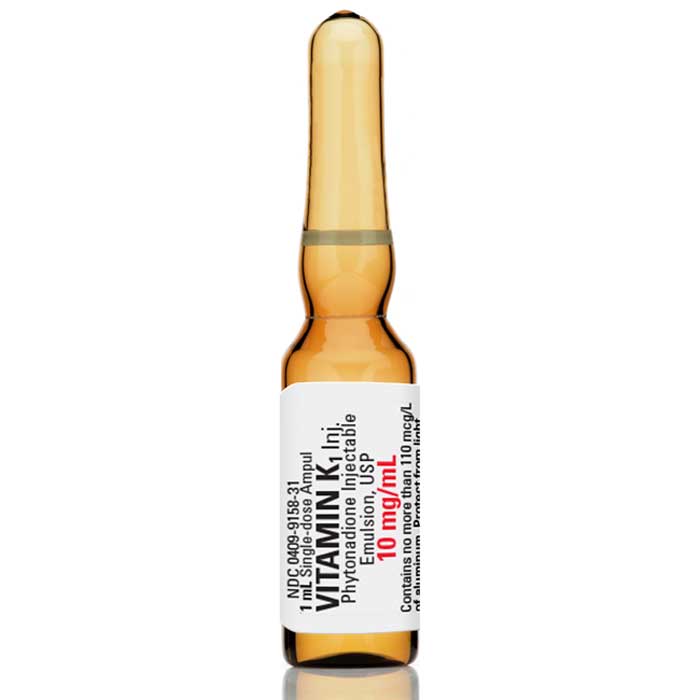
Vitamin K1 Injection (Phytonadione Injectable Emulsion) 10 mg/ mL by Pfizer 25/Pack

Sale 20%
Original price $ 2,750.00
Current price $ 2,200.00
SKU 00409-9158-01
*Mountainside Medical does not fill personal prescriptions Medical Professional License Required to Unlock Account

How to Order:

Send an email request to: sales@mountainside-medical.com

You will receive instructions on how to create an account along with Rx Ordering Details.

(Note: Acceptable licenses must have Prescriptive Authority in the license issuing state.)

Pfizer Vitamin K1 Injection (Phytonadione Injectable Emulsion) 1 mg/0.5 mL Neonatal is a prescription medication used to prevent and treat vitamin K deficiency in newborn babies. It is administered by injection and contains a synthetic form of vitamin K1, which helps the body to form blood clots and prevent bleeding. This injection may be recommended for babies who are at risk of vitamin K deficiency due to complications during delivery or certain medical conditions. It is often given to newborn babies shortly after birth as a routine preventative measure.

Vitamin K1 Injection (Phytonadione Injectable Emulsion, USP) aqueous dispersion of vitamin K1 for parenteral injection, possesses the same type and degree of activity as does naturally-occurring vitamin K, which is necessary for the production via the liver of active prothrombin (factor II), proconvertin (factor VII), plasma thromboplastin component (factor IX), and Stuart factor (factor X). The prothrombin test is sensitive to the levels of three of these four factors−II, VII, and X. Vitamin K is an essential cofactor for a microsomal enzyme that catalyzes the post-translational carboxylation of multiple, specific, peptide-bound glutamic acid residues in inactive hepatic precursors of factors II, VII, IX, and X. The resulting gamma-carboxy-glutamic acid residues convert the precursors into active coagulation factors that are subsequently secreted by liver cells into the blood.

Phytonadione is readily absorbed following intramuscular administration. After absorption, phytonadione is initially concentrated in the liver, but the concentration declines rapidly. Very little vitamin K accumulates in tissues. Little is known about the metabolic fate of vitamin K. Almost no free unmetabolized vitamin K appears in bile or urine.

In normal animals and humans, phytonadione is virtually devoid of pharmacodynamic activity. However, in animals and humans deficient in vitamin K, the pharmacological action of vitamin K is related to its normal physiological function, that is, to promote the hepatic biosynthesis of vitamin K dependent clotting factors.

The action of the aqueous dispersion, when administered intravenously, is generally detectable within an hour or two and hemorrhage is usually controlled within 3 to 6 hours. A normal prothrombin level may often be obtained in 12 to 14 hours.

In the prophylaxis and treatment of hemorrhagic disease of the newborn, phytonadione has demonstrated a greater margin of safety than that of the water-soluble vitamin K analogues.

Indications and Usage

Vitamin K1 Injection (Phytonadione Injectable Emulsion, USP) is indicated in the following coagulation disorders which are due to faulty formation of factors II, VII, IX and X when caused by vitamin K deficiency or interference with vitamin K activity.

Vitamin K1 Injection is indicated in:anticoagulant-induced prothrombin deficiency caused by coumarin or indanedione derivatives; prophylaxis and therapy of hemorrhagic disease of the newborn; hypoprothrombinemia due to antibacterial therapy;

hypoprothrombinemia secondary to factors limiting absorption or synthesis of vitamin K, e.g., obstructive jaundice, biliary fistula, sprue, ulcerative colitis, celiac disease, intestinal resection, cystic fibrosis of the pancreas, and regional enteritis; other drug-induced hypoprothrombinemia where it is definitely shown that the result is due to interference with vitamin K metabolism, e.g., salicylates.

Vitamin K1 Injection (Phytonadione Injectable Emulsion) 10 mg/ mL by Pfizer 25/Pack
$ 2,750.00 $ 2,200.00
🔒 Medical License Required
FAQs for Vitamin K injections - – Fast-Acting Solution for Bleeding Disorders & Deficiency!
  • What is the Vitamin K Injection Used For?

    Vitamin K injections are primarily used to prevent and treat vitamin K deficiency, which can cause dangerous bleeding disorders. They are essential in: Newborns: Preventing Vitamin K Deficiency Bleeding (VKDB). Adults: Managing bleeding caused by anticoagulant (warfarin) overdose or liver disease, and correcting clotting factor deficiencies.

  • Where to Give Vitamin K Injection in Adults?

    The recommended sites for adults are: Intramuscular (IM) Injection: Upper outer quadrant of the buttock (gluteal muscle) or the deltoid muscle of the upper arm. Intravenous (IV) Injection: Into a vein by a trained healthcare provider. Subcutaneous Injection: Under the skin—used less frequently.

  • Why Are Parents Refusing Vitamin K?

    Some parents decline Vitamin K injections for their newborns due to: Misplaced fears about side effects Preference for "natural" approaches Misunderstandings about safety versus oral alternatives Fact: Clinical evidence overwhelmingly supports the safety and necessity of Vitamin K injections to prevent life-threatening bleeding in newborns.

  • Why Would a Doctor Give You Vitamin K?

    A doctor may recommend Vitamin K injections if you: Suffer from Vitamin K deficiency Experience unexplained bleeding or bruising Are on blood-thinning medications like warfarin Require surgery or have liver disease affecting clotting factors

  • Disadvantages of Vitamin K Injections

    While generally safe, possible side effects include: Injection site swelling or pain Rare allergic reactions (anaphylaxis) Risk of improper administration if not performed by professionals

  • Which is the Best Site for Vitamin K Injection?

    Top choices for optimal absorption and low risk: Intramuscular: Deltoid or vastus lateralis (thigh) in infants and children, gluteal muscle or deltoid in adults. Intravenous is chosen for emergency situations.

  • How Quickly Does IV Vitamin K Work?

    Intravenous Vitamin K kicks in fast—typically within 1-2 hours—making it ideal for urgent correction of clotting issues due to anticoagulant overdose or acute bleeding.

  • How to Give Vitamin K IV Injection?

    Administration must be slow (over at least 30 seconds) and performed by licensed professionals to avoid injection reactions. Follow strict aseptic technique and product guidelines.

  • Is Injected Vitamin K Better Than Oral?

    Injected Vitamin K offers superior absorption—especially for: Newborns Patients with malabsorption conditions Urgent bleeding scenarios Oral Vitamin K is suitable for long-term maintenance but is less reliable in acute situations.

  • What Disease Can You Get from Lack of Vitamin K?

    Severe deficiency can cause: Vitamin K Deficiency Bleeding (VKDB) Hemorrhagic disease of the newborn Uncontrolled internal or external bleeding in adults

  • Four Signs of Vitamin K Deficiency:

    Easy bruising Frequent nosebleeds Blood in urine or stool Excessive bleeding from minor wounds or surgical site

  • Foods Highest in Vitamin K:

    Leafy green vegetables: Kale, spinach, collard greens, Swiss chard, and broccoli are the top sources.

  • Other Names for Vitamin K Injection:

    Phytonadione injection AquaMEPHYTON Konakion

  • Medications That Interact with Vitamin K:

    Anticoagulants: Warfarin (Coumadin) Certain antibiotics Orlistat (weight-loss medication) Cholestyramine (cholesterol medication)

Search Any Type of Product, Medication, or Alignment