
Calcium Gluconate Injection & IV Calcium Gluconate
Calcium Gluconate Injection
Calcium gluconate injection is a sterile intravenous calcium supplement. It is commonly supplied as a 10% solution (10 mL vials, containing 1 g calcium gluconate, which provides about 93 mg elemental Ca²⁺). Because calcium gluconate contains much less elemental calcium than calcium chloride, it is a milder form of IV calcium (roughly one‐third the calcium of an equal volume of 10% CaCl₂). Calcium gluconate is used to acutely raise blood calcium and stabilize the heart in certain emergencies. It is the form of IV calcium most often used for hypocalcemia and can be given safely by peripheral IV (unlike CaCl₂, which is very irritating).
Uses
IV calcium gluconate is indicated when rapid calcium correction or cardiac stabilization is needed. Typical emergency uses include:
- Severe hypocalcemia: In life-threatening low calcium (e.g. acute hypoparathyroidism, post-thyroidectomy tetany, massive blood transfusion with citrate toxicity), IV calcium gluconate quickly raises serum Ca²⁺. (For very acute, severe cases, some protocols prefer calcium chloride because it delivers more elemental Ca, but calcium gluconate is often first‐line for IV replacement of calcium.)
- Hyperkalemia: When blood potassium is dangerously high or ECG shows changes (peaked T waves, widened QRS), IV calcium gluconate is given to stabilize cardiac membranes. The extra Ca²⁺ protects the heart from the cardiotoxic effects of hyperkalemia and can temporarily reduce arrhythmia risk.
- Hypermagnesemia: In magnesium overdose (e.g. excessive IV Mg in eclampsia or renal failure), calcium gluconate antagonizes magnesium’s neuromuscular and cardiac depressant effects. It can reverse magnesium-induced hypotension and respiratory depression.
- Other critical uses: Calcium gluconate may also be used in severe calcium-channel blocker overdose or hydrofluoric acid exposure. In fluoride burns, for example, IV (or topical) calcium gluconate binds free fluoride to form CaF₂ and helps prevent systemic hypocalcemia. (Topical 2.5% CaG gel for HF burns is well known; IV CaG is given if fluoride ingestion or signs of systemic toxicity.
Calcium Gluconate Dosage
Calcium gluconate is given by intravenous injection or infusion only. It must not be given by muscle or under the skin. (Indeed, it is “not recommended for injection into a muscle”. It is typically diluted (e.g. 10–30 mL of 10% solution in 50–100 mL IV fluid) and infused slowly over 5–10 minutes. A common adult dose is 1 g (10 mL of 10% solution) IV over several minutes; this can be repeated as needed with monitoring. Some references say up to 1–2 g (10–20 mL) IV, repeated every 10–20 minutes, until calcium levels or ECG normalize. Infusion should be done with cardiac monitoring. Unlike calcium chloride, calcium gluconate is less irritating, so it can often be given via a large peripheral IV. However, care should still be taken: verify good IV placement and monitor the patient during the infusion.
Side Effects
Like all IV calcium salts, calcium gluconate must be used cautiously:
- Administration rate: Too-rapid infusion can cause bradycardia, hypotension, or arrhythmias. Infuse each dose over at least 5 minutes while monitoring the ECG. Patients often feel warmth or a flushing sensation during infusion.
- Injection-site reactions: Calcium gluconate can irritate veins. It often causes infusion-site pain. Extravasation (leakage into tissues) may cause local necrosis, though CaG is less caustic than CaCl₂. Always check IV patency; using a central line is safest if available.
- Hypercalcemia: Do not administer if blood calcium is already high. Overcorrection can lead to hypercalcemia (which can cause confusion, kidney stones, arrhythmias). Calcium levels should be rechecked if multiple doses are given.
- Drug interactions: Avoid mixing calcium solutions with phosphate or bicarbonate-containing IV fluids (precipitation can occur). In patients on digoxin (digitalis), IV calcium can precipitate dangerous arrhythmias, so use extreme caution.
- Other side effects: Rarely, severe reactions can occur. Common transient effects are low blood pressure and slowing of the heartbeat during the infusion.
Calcium gluconate injection is a 10% IV calcium solution used for acute hypocalcemia and to stabilize cardiac conduction in hyperkalemia or hypermagnesemia. It is less concentrated than calcium chloride and is the usual IV calcium of choice when peripheral access is used. Because it is potent and can cause harm if misused, it must be given under medical supervision with appropriate dilution and monitoring
-
 Sale 18%
Original price $ 479.95Current price $ 395.00
Sale 18%
Original price $ 479.95Current price $ 395.00Calcium Gluconate Injection 1000 mg per 10 ml vial Single-Dose vials 10 mL x 25/Tray (Rx)
INDEPENDENCE DAY 10% OFFSpend $100, you'd pay Qualifying order You've reached $100 — 10% off is now active $ 355.50Calcium Gluconate for Injection 1000 mg per 10 ml vial Single-Dose vials is a sterile solution of calcium gluconate, a mineral supplement, in a sin...
View full details -
 Sale 28%
Original price $ 1,250.00Current price $ 899.00
Sale 28%
Original price $ 1,250.00Current price $ 899.00Calcium Gluconate Injection 5000 mg per 50 ml vial Single-Dose vials 50 mL x 25/Tray (Rx)
INDEPENDENCE DAY 10% OFFSpend $100, you'd pay Qualifying order You've reached $100 — 10% off is now active $ 809.10Calcium Gluconate Injection 5000 mg is a sterile, non-pyrogenic injectable solution that provides a rapid and reliable source of calcium for intrav...
View full details -
 Sale 20%
Original price $ 225.00Current price $ 179.00
Sale 20%
Original price $ 225.00Current price $ 179.00Calcium Gluconate Injection 1000 mg per 10 mL (100 mg per mL) SDV 10 mL x 10/Pack (Rx)
INDEPENDENCE DAY 10% OFFSpend $100, you'd pay Qualifying order You've reached $100 — 10% off is now active $ 161.10Calcium Gluconate Injection 1000 mg usually refers to a single-dose 10 mL vial containing a sterile 10% solution for intravenous administration...
View full details -
 Sale 25%
Original price $ 2,195.95Current price $ 1,650.00
Sale 25%
Original price $ 2,195.95Current price $ 1,650.00Calcium Gluconate for Injection 1000mg per 10 ml vial Multiple-Dose vials 10 mL x 25/Tray (Rx)
INDEPENDENCE DAY 10% OFFSpend $100, you'd pay Qualifying order You've reached $100 — 10% off is now active $ 1,485.00Fresenius Kabi Calcium Gluconate for Injection 1,000 mg per 10 mL (100 mg per mL) vial Multiple Dose vials 10 mL. Fresenius Kabi Calcium Gluconate ...
View full details -
 Sale 28%
Original price $ 725.00Current price $ 519.00
Sale 28%
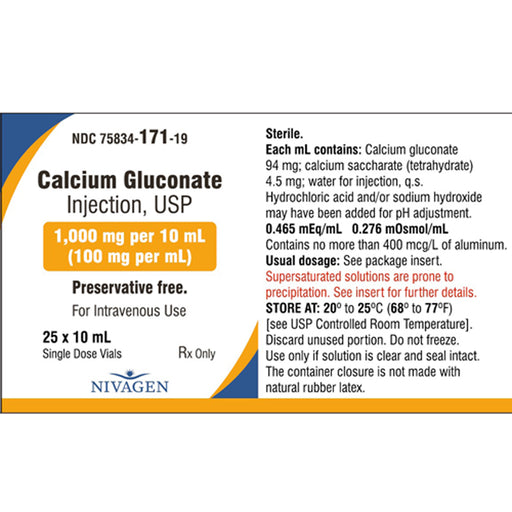
Original price $ 725.00Current price $ 519.00Calcium Gluconate for Injection 1000mg per 10 ml vial Single-Dose vials 10 mL x 25/Tray (Rx)
INDEPENDENCE DAY 10% OFFSpend $100, you'd pay Qualifying order You've reached $100 — 10% off is now active $ 467.10Calcium gluconate for injection is a medication used to treat low levels of calcium in the blood. It is a sterile solution containing 1000mg of cal...
View full details -
 Sale 25%
Original price $ 1,999.95Current price $ 1,495.00
Sale 25%
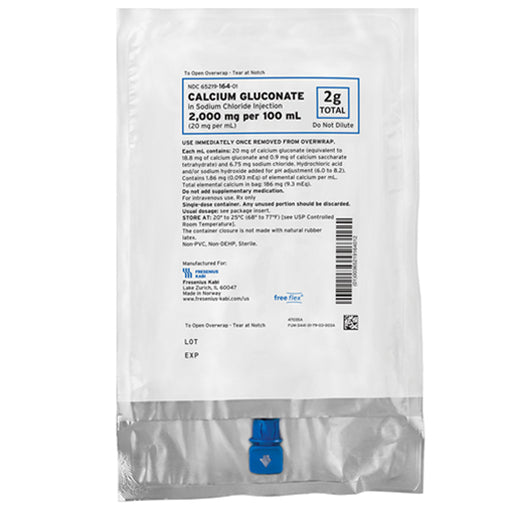
Original price $ 1,999.95Current price $ 1,495.00Calcium Gluconate in Sodium Chloride Injection Freeflex 2,000 mg per 100 mL 24/Case (Rx)
INDEPENDENCE DAY 10% OFFSpend $100, you'd pay Qualifying order You've reached $100 — 10% off is now active $ 1,345.50Calcium Gluconate in Sodium Chloride Injection Freeflex 2,000 mg per 100 mL is used as a source of calcium to maintain the serum calcium level in t...
View full details




Calcium Gluconate Injection
Calcium gluconate injection is a sterile intravenous calcium supplement. It is commonly supplied as a 10% solution (10 mL vials, containing 1 g calcium gluconate, which provides about 93 mg elemental Ca²⁺). Because calcium gluconate contains much less elemental calcium than calcium chloride, it is a milder form of IV calcium (roughly one‐third the calcium of an equal volume of 10% CaCl₂). Calcium gluconate is used to acutely raise blood calcium and stabilize the heart in certain emergencies. It is the form of IV calcium most often used for hypocalcemia and can be given safely by peripheral IV (unlike CaCl₂, which is very irritating).
Uses
IV calcium gluconate is indicated when rapid calcium correction or cardiac stabilization is needed. Typical emergency uses include:
- Severe hypocalcemia: In life-threatening low calcium (e.g. acute hypoparathyroidism, post-thyroidectomy tetany, massive blood transfusion with citrate toxicity), IV calcium gluconate quickly raises serum Ca²⁺. (For very acute, severe cases, some protocols prefer calcium chloride because it delivers more elemental Ca, but calcium gluconate is often first‐line for IV replacement of calcium.)
- Hyperkalemia: When blood potassium is dangerously high or ECG shows changes (peaked T waves, widened QRS), IV calcium gluconate is given to stabilize cardiac membranes. The extra Ca²⁺ protects the heart from the cardiotoxic effects of hyperkalemia and can temporarily reduce arrhythmia risk.
- Hypermagnesemia: In magnesium overdose (e.g. excessive IV Mg in eclampsia or renal failure), calcium gluconate antagonizes magnesium’s neuromuscular and cardiac depressant effects. It can reverse magnesium-induced hypotension and respiratory depression.
- Other critical uses: Calcium gluconate may also be used in severe calcium-channel blocker overdose or hydrofluoric acid exposure. In fluoride burns, for example, IV (or topical) calcium gluconate binds free fluoride to form CaF₂ and helps prevent systemic hypocalcemia. (Topical 2.5% CaG gel for HF burns is well known; IV CaG is given if fluoride ingestion or signs of systemic toxicity.
Calcium Gluconate Dosage
Calcium gluconate is given by intravenous injection or infusion only. It must not be given by muscle or under the skin. (Indeed, it is “not recommended for injection into a muscle”. It is typically diluted (e.g. 10–30 mL of 10% solution in 50–100 mL IV fluid) and infused slowly over 5–10 minutes. A common adult dose is 1 g (10 mL of 10% solution) IV over several minutes; this can be repeated as needed with monitoring. Some references say up to 1–2 g (10–20 mL) IV, repeated every 10–20 minutes, until calcium levels or ECG normalize. Infusion should be done with cardiac monitoring. Unlike calcium chloride, calcium gluconate is less irritating, so it can often be given via a large peripheral IV. However, care should still be taken: verify good IV placement and monitor the patient during the infusion.
Side Effects
Like all IV calcium salts, calcium gluconate must be used cautiously:
- Administration rate: Too-rapid infusion can cause bradycardia, hypotension, or arrhythmias. Infuse each dose over at least 5 minutes while monitoring the ECG. Patients often feel warmth or a flushing sensation during infusion.
- Injection-site reactions: Calcium gluconate can irritate veins. It often causes infusion-site pain. Extravasation (leakage into tissues) may cause local necrosis, though CaG is less caustic than CaCl₂. Always check IV patency; using a central line is safest if available.
- Hypercalcemia: Do not administer if blood calcium is already high. Overcorrection can lead to hypercalcemia (which can cause confusion, kidney stones, arrhythmias). Calcium levels should be rechecked if multiple doses are given.
- Drug interactions: Avoid mixing calcium solutions with phosphate or bicarbonate-containing IV fluids (precipitation can occur). In patients on digoxin (digitalis), IV calcium can precipitate dangerous arrhythmias, so use extreme caution.
- Other side effects: Rarely, severe reactions can occur. Common transient effects are low blood pressure and slowing of the heartbeat during the infusion.
Calcium gluconate injection is a 10% IV calcium solution used for acute hypocalcemia and to stabilize cardiac conduction in hyperkalemia or hypermagnesemia. It is less concentrated than calcium chloride and is the usual IV calcium of choice when peripheral access is used. Because it is potent and can cause harm if misused, it must be given under medical supervision with appropriate dilution and monitoring
Calcium Deficiency Disorders & Signs
Chronic or acute calcium deficiency in the body leads to several well-known disorders, each with characteristic clinical features:
-
Hypocalcemia (acute low blood calcium). Leads to neuromuscular excitability. Early symptoms include perioral and fingertip tingling, muscle cramps and involuntary spasms (tetany). Severe hypocalcemia can cause seizures, confusion and dangerous heart rhythm disturbances. Physical exam may reveal a positive Chvostek sign (facial twitching when tapping the cheek) and Trousseau sign (spasm of the hand with a blood pressure cuff). Carpopedal spasms (persistent flexion of the fingers/feet) are another classic finding.
-
Rickets (children). Chronic Ca (and vitamin D) deficiency causes defective bone mineralization in growing children. Signs include bowed legs or knock-knees, a prominent forehead (frontal bossing), widening of the wrist and ankle joints, and a “rachitic rosary” (beading along the ribs). Affected children also have stunted growth, bone pain and irritability. Dental problems (delayed tooth eruption, enamel defects) and skeletal deformities (spine curvature) may occur if untreated.
-
Osteomalacia (adults). This is the adult counterpart of rickets – softening of bones from long-term calcium and vitamin D deficiency. Patients have diffuse bone pain (often in the hips and legs) and proximal muscle weakness. Bones become soft and pliable, leading to a higher risk of fractures even with mild trauma. Laboratory tests typically show low blood calcium and phosphate with elevated alkaline phosphatase (not shown here).
-
Osteoporosis (bone thinning). Over many years, inadequate calcium/Vit-D intake (especially in the elderly) contributes to osteoporosis. It is often silent at first, but leads to loss of bone mass and a high risk of fractures. Clinically, patients may develop sudden back pain from vertebral compression fractures, a gradual loss of height, and a stooped (kyphotic) posture. Fractures of the hip, wrist or spine are common “presenting” events once bone density is low.
In summary, calcium deficiency primarily presents as hypocalcemia with neuromuscular irritability (tingling, tetany, seizures, arrhythmias), and chronic deficiency leads to bone mineralization disorders – rickets in children (bone deformities, bowed legs, dental problems) and osteomalacia in adults (bone pain, muscle weakness). Long-term poor intake also contributes to osteoporosis, marked by fragility fractures, back pain and a humped posture.
Calcium Gluconate Injection Dosing
Calcium gluconate (10% solution, 100 mg/mL) is used IV for acute hypocalcemia and related emergencies. Each mL contains about 9.3 mg elemental Ca. Dosing varies by age and indication:
-
Adults (acute hypocalcemia): A typical initial dose is 1–2 g IV (10–20 mL of 10% solution) given slowly (over ~5–10 minutes). This may be repeated if needed (for example, until symptoms improve). For example, one guideline recommends 10–20 mL (1–2 g) IV over 10 min, repeating as necessary, followed by an infusion if hypocalcemia persists. Subsequent bolus doses are often 1–2 g every 6 h as needed. A continuous infusion can also be used: adults may start around 5.4–21.5 mg/kg/hr of Ca gluconate (not exceeding ~200 mg/min total rate. Dose should be titrated to correct calcium levels and cease when underlying cause is addressed.
-
Pediatric (acute hypocalcemia): Doses are weight-based. For neonates (<1 month), an initial bolus of 100–200 mg/kg IV is given (~0.5–1 mL/kg of 10%). Infants/children (1 month to <18 y) receive 29–60 mg/kg IV. These boluses can be repeated every ~6 h if needed. For ongoing therapy, infusion rates may be 17–33 mg/kg/hr (neonates) or 8–13 mg/kg/hr (older children). Do not exceed ~100 mg/min infusion rate in children.
-
Hypocalcemic tetany or severe symptoms: A larger bolus is used. For example, 100–300 mg elemental Ca (~3 g calcium gluconate) IV over 5–10 min, followed by a continuous infusion (~0.5–2 mg/kg/hr elemental Ca) to restore normocalcemia. In practical terms, ~3 g (30 mL) of 10% solution is common for an urgent bolus.
-
Hyperkalemia (with ECG changes): IV calcium gluconate protects the heart. One recommendation is 6.8 mmol of Ca (≈30 mL of 10%) IV over a few minutes. This is roughly 2–3 g of Ca gluconate, supplying ~170–280 mg elemental Ca.
-
Hypermagnesemia: A similar dose (1.5–3 g IV over 2–5 min) is used to counteract magnesium toxicity.
-
Calcium-channel blocker overdose: High-dose calcium is used. For example, 60 mg/kg IV (up to ~3–4 g total) over 5 min, repeated up to 3–4 times (not exceeding ~3–4 g per dose), often with a concurrent infusion.
-
Magnesium sulfate toxicity (eclampsia): Typically 0.5 mL/kg (≈50 mg/kg) IV of 10% solution, up to 10 mL (1 g) in adults, as an antidote to excess Mg²⁺.
Administration: Calcium gluconate must be given IV (never IM/SC) and usually diluted (e.g. in D5W or NS). Infuse slowly: do not exceed ~200 mg/min in adults (100 mg/min in children). Continuous ECG and calcium monitoring are recommended during treatment.
Calcium Deficiency Disorders & Signs
Chronic or acute calcium deficiency in the body leads to several well-known disorders, each with characteristic clinical features:
-
Hypocalcemia (acute low blood calcium). Leads to neuromuscular excitability. Early symptoms include perioral and fingertip tingling, muscle cramps and involuntary spasms (tetany). Severe hypocalcemia can cause seizures, confusion and dangerous heart rhythm disturbances. Physical exam may reveal a positive Chvostek sign (facial twitching when tapping the cheek) and Trousseau sign (spasm of the hand with a blood pressure cuff). Carpopedal spasms (persistent flexion of the fingers/feet) are another classic finding.
-
Rickets (children). Chronic Ca (and vitamin D) deficiency causes defective bone mineralization in growing children. Signs include bowed legs or knock-knees, a prominent forehead (frontal bossing), widening of the wrist and ankle joints, and a “rachitic rosary” (beading along the ribs). Affected children also have stunted growth, bone pain and irritability. Dental problems (delayed tooth eruption, enamel defects) and skeletal deformities (spine curvature) may occur if untreated.
-
Osteomalacia (adults). This is the adult counterpart of rickets – softening of bones from long-term calcium and vitamin D deficiency. Patients have diffuse bone pain (often in the hips and legs) and proximal muscle weakness. Bones become soft and pliable, leading to a higher risk of fractures even with mild trauma. Laboratory tests typically show low blood calcium and phosphate with elevated alkaline phosphatase (not shown here).
-
Osteoporosis (bone thinning). Over many years, inadequate calcium/Vit-D intake (especially in the elderly) contributes to osteoporosis. It is often silent at first, but leads to loss of bone mass and a high risk of fractures. Clinically, patients may develop sudden back pain from vertebral compression fractures, a gradual loss of height, and a stooped (kyphotic) posture. Fractures of the hip, wrist or spine are common “presenting” events once bone density is low.
In summary, calcium deficiency primarily presents as hypocalcemia with neuromuscular irritability (tingling, tetany, seizures, arrhythmias), and chronic deficiency leads to bone mineralization disorders – rickets in children (bone deformities, bowed legs, dental problems) and osteomalacia in adults (bone pain, muscle weakness). Long-term poor intake also contributes to osteoporosis, marked by fragility fractures, back pain and a humped posture.
Calcium Gluconate Injection Dosing
Calcium gluconate (10% solution, 100 mg/mL) is used IV for acute hypocalcemia and related emergencies. Each mL contains about 9.3 mg elemental Ca. Dosing varies by age and indication:
-
Adults (acute hypocalcemia): A typical initial dose is 1–2 g IV (10–20 mL of 10% solution) given slowly (over ~5–10 minutes). This may be repeated if needed (for example, until symptoms improve). For example, one guideline recommends 10–20 mL (1–2 g) IV over 10 min, repeating as necessary, followed by an infusion if hypocalcemia persists. Subsequent bolus doses are often 1–2 g every 6 h as needed. A continuous infusion can also be used: adults may start around 5.4–21.5 mg/kg/hr of Ca gluconate (not exceeding ~200 mg/min total rate. Dose should be titrated to correct calcium levels and cease when underlying cause is addressed.
-
Pediatric (acute hypocalcemia): Doses are weight-based. For neonates (<1 month), an initial bolus of 100–200 mg/kg IV is given (~0.5–1 mL/kg of 10%). Infants/children (1 month to <18 y) receive 29–60 mg/kg IV. These boluses can be repeated every ~6 h if needed. For ongoing therapy, infusion rates may be 17–33 mg/kg/hr (neonates) or 8–13 mg/kg/hr (older children). Do not exceed ~100 mg/min infusion rate in children.
-
Hypocalcemic tetany or severe symptoms: A larger bolus is used. For example, 100–300 mg elemental Ca (~3 g calcium gluconate) IV over 5–10 min, followed by a continuous infusion (~0.5–2 mg/kg/hr elemental Ca) to restore normocalcemia. In practical terms, ~3 g (30 mL) of 10% solution is common for an urgent bolus.
-
Hyperkalemia (with ECG changes): IV calcium gluconate protects the heart. One recommendation is 6.8 mmol of Ca (≈30 mL of 10%) IV over a few minutes. This is roughly 2–3 g of Ca gluconate, supplying ~170–280 mg elemental Ca.
-
Hypermagnesemia: A similar dose (1.5–3 g IV over 2–5 min) is used to counteract magnesium toxicity.
-
Calcium-channel blocker overdose: High-dose calcium is used. For example, 60 mg/kg IV (up to ~3–4 g total) over 5 min, repeated up to 3–4 times (not exceeding ~3–4 g per dose), often with a concurrent infusion.
-
Magnesium sulfate toxicity (eclampsia): Typically 0.5 mL/kg (≈50 mg/kg) IV of 10% solution, up to 10 mL (1 g) in adults, as an antidote to excess Mg²⁺.
Administration: Calcium gluconate must be given IV (never IM/SC) and usually diluted (e.g. in D5W or NS). Infuse slowly: do not exceed ~200 mg/min in adults (100 mg/min in children). Continuous ECG and calcium monitoring are recommended during treatment.